
Standing Inside the Time We’re Given

When nothing appears to be moving, something deeper is still unfolding.
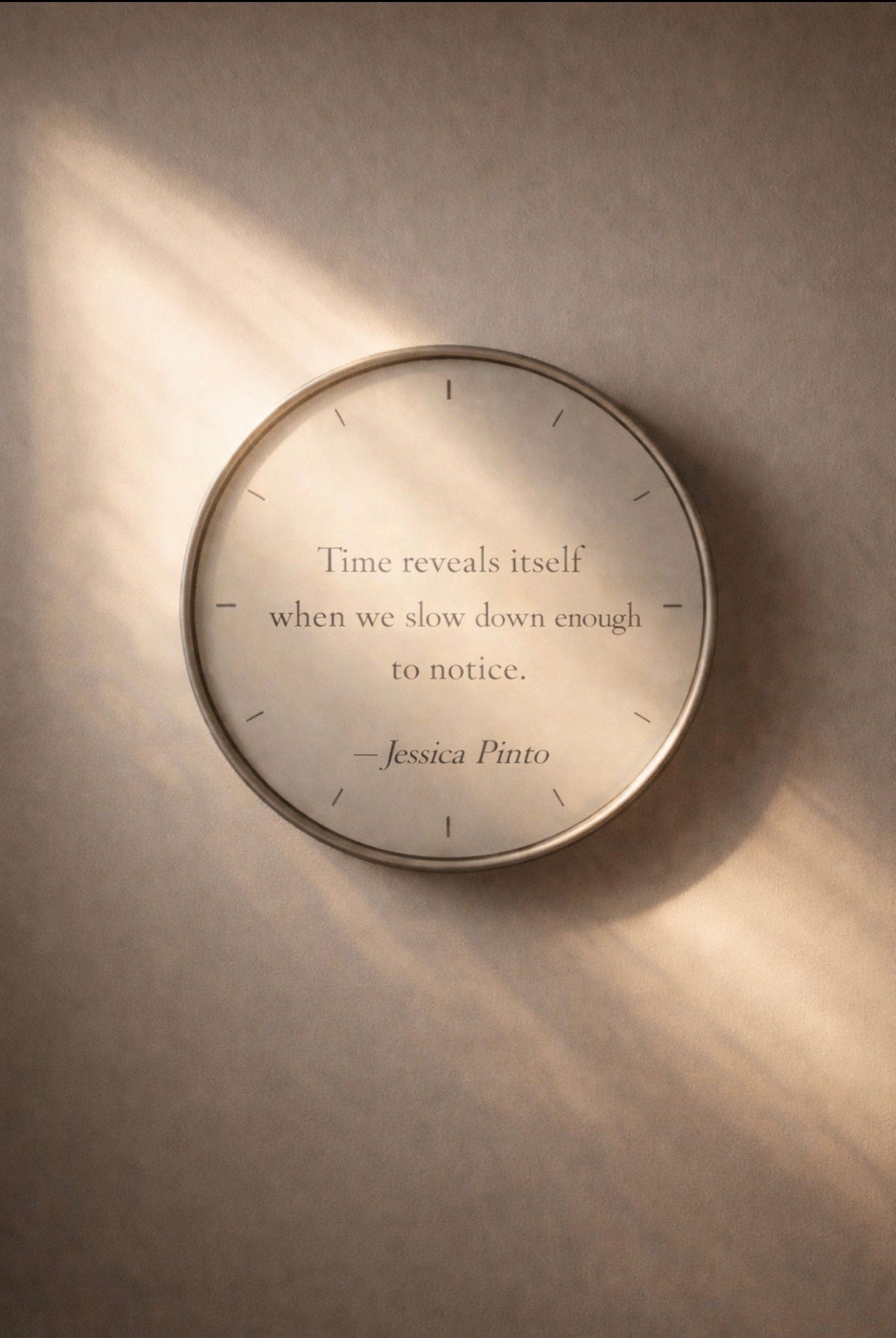
I think about a clock without hands.
No ticking. No numbers demanding attention. No visible proof that anything is moving at all.
And yet, time is still at work.
Not rushing. Not announcing itself. Just unfolding quietly, whether we choose to notice it or not.
We tell ourselves there will be time later. That something meaningful waits somewhere ahead of us.
But time doesn’t pause. And it doesn’t rewind.
It keeps moving forward, even when we stay exactly where we are.
Most of the time, we don’t notice it leaving.
Not because something dramatic happened,
but because nothing did.
It slips away in the everyday.
The calendar fills.
The weeks blur.
The routines tighten.
You wake up.
You perform.
You manage.
You respond.
You tell yourself you’ll slow down soon.
You mean it.
And then you look up, and another year is gone.
It isn’t time that speeds up.
It’s us.
We rush.
We multitask the moment.
We half-listen.
We live in the next thing before this one finishes.
We postpone the very life we’re living
for when things slow down.
When there’s more space.
When there’s more time.
I used to live that way.
Work first. Me last.
I called it ambition.
I called it discipline.
I called it being dependable.
What I didn’t call it was depletion.
You can only override yourself for so long.
For me, that truth became personal when I was forced to face how fragile “later” actually is.
How easily we assume it will be there.
How quietly it can change.
That’s when “later” stopped feeling guaranteed.
Healing didn’t mean I stopped working.
It meant I stopped building a life that put me last.
And once I stopped living on autopilot, something uncomfortable surfaced.
I realized I wasn’t even sure what I was protecting my time for.
I had built a life that looked full.
But I hadn’t paused long enough to ask what actually filled me.
That’s when the question hit harder than I expected:
What actually makes my soul happy?
Not what looks good on paper.
Not what earns approval.
Not what keeps me busy.
But what makes me come alive.
What feels like oxygen instead of obligation.
Somewhere along the way, many of us stopped asking that question.
Some of us live looking backward.
Others live fixed on what’s ahead, convinced everything begins once we get there.
I understand that instinct.
Surviving wired me to look ahead.
Rebuilding is teaching me how to stay.
I used to believe presence would come after progress.
Now I’m realizing the moment I’m rushing through is the one I’m actually living.
Time doesn’t feel like a clock to me anymore.
It feels more like an hourglass.
Quiet.
Steady.
Emptying whether I’m paying attention or not.
And when we’re not fully here, time doesn’t just pass.
It changes things.
The call we meant to make.
The friend we assumed we’d reconnect with.
The relative we thought we had more time with.
Distance forms.
Life shifts.
Sometimes, someone is gone.
What we miss most isn’t the busyness.
It’s the time we assumed we still had.
We spend so much time talking about “living once.”
As if life is one big moment we’re supposed to maximize.
But that isn’t how it works.
We don’t live once.
We live every day.
In the ordinary.
In the unfinished.
In the middle of things we assume we’ll appreciate later.
And at some point, the number of days ahead quietly becomes smaller than the ones behind.
Time keeps moving.
It always has.
The only question is whether we are awake inside it.
Today, don’t just multitask less.
Connect more.
Put your phone down at dinner.
Look across the table instead of at a screen.
Finish the conversation without reaching for a notification.
Let someone feel your full attention.
Because distance doesn’t only happen over years.
It happens in inches.
In glances away.
In moments we were physically there but not truly present.
Be here.
Fully.
This moment, ordinary, imperfect, unfinished,
is the only one you are guaranteed.
And one day, it will be the time you wish you had.
If this resonated, you’re welcome to stay.
We tend to hold off on anything meaningful until xyz is done. The inexorable passage of time is the strongest message of this piece. If time doesn’t wait for anyone, what are we waiting for? This piece is so relatable.
What struck me most is the idea that we don’t lose time dramatically. We lose it incrementally.
In habits. In routines. In autopilot.
Distance forms the same way pain does: quietly, through repetition.
This felt like an invitation to interrupt that.